







How to Choose Pressure Sensitive Hot Melt Adhesive for Fly Trap Balls Used in Orchards and Gardens
Fly trap balls are effective for capturing fruit flies and houseflies in orchards and gardens by attracting pests and holding them on a sticky surface. Their performance largely depends on the pressure sensitive hot melt adhesive used on the surface. A suitable PSA provides strong tack, long-lasting adhesion, and resistance to rain, sunlight, heat, and humidity, making it ideal for outdoor agricultural use. Choosing the right adhesive formulation is important because poor tack, weak durability, or UV degradation can reduce pest control performance and increase maintenance during seasonal use.
What Factors Should Be Considered When Selecting a Pressure Sensitive Hot Melt Adhesive for Fly Trap Balls?
Adhesives are chosen based on a number of environmental and material related criteria to achieve long-term bond performance.
Environmental Conditions in Orchards and Gardens
Outdoor fly traps are exposed to intense sunlight, variable humidity levels, and temperature fluctuations that can compromise adhesive stability. UV stability is crucial because prolonged exposure to sunlight can cause oxidation or embrittlement of the adhesive film. Moisture resistance is equally important; without it, the adhesive may lose its grip during rainy or humid conditions. Therefore, formulations incorporating UV stabilizers and hydrophobic components maintain consistent adhesion even under challenging weather patterns typical of orchard environments.
Surface Compatibility of the Adhesive with Trap Materials
The substrate material of fly trap balls—commonly plastic or rubber—must be compatible with the selected hot melt adhesive. Poor bonding between the adhesive layer and substrate can lead to delamination or reduced tack over time. Surface energy plays a decisive role; materials with low surface energy require specially modified adhesives containing polar additives or primers to enhance wetting behavior. Evaluating surface roughness also helps determine whether mechanical interlocking contributes positively to adhesion strength.
Tackiness and Peel Strength Requirements
This parameter measures how quickly an insect can stick to the surface of the fly trap ball. The adhesive used for coating the balls should provide enough initial tack to support fast insect attachment. At the same time, it should not flow, run, or spread excessively under high-temperature outdoor conditions. Peel strength indicates how firmly the adhesive remains bonded to the ball core during use. Good peel performance helps improve durability and resistance to environmental influences such as wind, dust, sunlight, and humidity. In this application, tackiness and cohesive strength need to be carefully balanced. Sufficient tack is required for rapid insect capture, while adequate cohesive strength helps prevent the adhesive layer from being pulled away from the core too early. However, excessively high cohesive strength may increase melt viscosity and make coating more difficult during production. Therefore, a well-designed commercial formulation should balance tack, cohesion, heat resistance, and processability, so that the adhesive can perform reliably outdoors while remaining suitable for efficient production-line coating.
How Does Formulation Influence Adhesive Performance?
The performance of a pressure sensitive hot melt adhesive in field applications is dictated by the formulation chemistry.
Role of Tackifiers and Plasticizers in Adjusting Adhesive Properties
Tackifiers can be added to modify the surface energy and to increase the tack to certain insects. Hydrocarbon resins as well as terpene-based resins are typical tackifiers. They have to be compatible with the base polymer. Additives like mineral oil as plasticizer improve flexibility at low temperatures. They prevent brittleness in cold periods. The ratio of polymer, tackifier and oil determines the viscosity as well as the long term stability against oxidation or even phase separation.
Additives for Durability Enhancement
Additives such as UV stabilizers can be incorporated into the adhesive to protect it against outdoor exposure to sunlight which can cause degradation of the adhesive leading to it becoming yellow or hard. The antioxidants in the adhesive can extend the storage life of the product by preventing thermal oxidation during manufacture and use. In addition to these functions colorants or pigments can be added to the adhesive to match a particular color code without affecting the adhesive’s bonding properties.
How to Evaluate the Quality of a Pressure Sensitive Hot Melt Adhesive?
Evaluating PSA quality requires both laboratory analysis and field validation under real-world conditions.
Laboratory Testing Parameters for Performance Validation
Laboratory tests quantify key metrics including shear resistance, peel adhesion, loop tack, viscosity stability, and aging performance. Thermal analysis techniques such as Differential Scanning Calorimetry (DSC) identify softening points critical for predicting temperature tolerance ranges. Accelerated weathering tests simulate months of outdoor exposure within controlled chambers that replicate UV radiation intensity and humidity cycles found in orchards.
Field Testing on Actual Fly Trap Applications
The field trials confirm the results from the laboratory. Coated fly trap balls are exposed to natural weather for several weeks or even months. The capture rate of flies is measured and compared to the baseline parameters of the coated fly trap balls which have been tested during the test phases. On the basis of the visual control of the dust accumulation and the decrease of the stickiness of the surface of the coated fly trap balls the time of reapplication can be determined.
Why Is Supplier Selection Crucial When Sourcing Pressure Sensitive Hot Melt Adhesives?
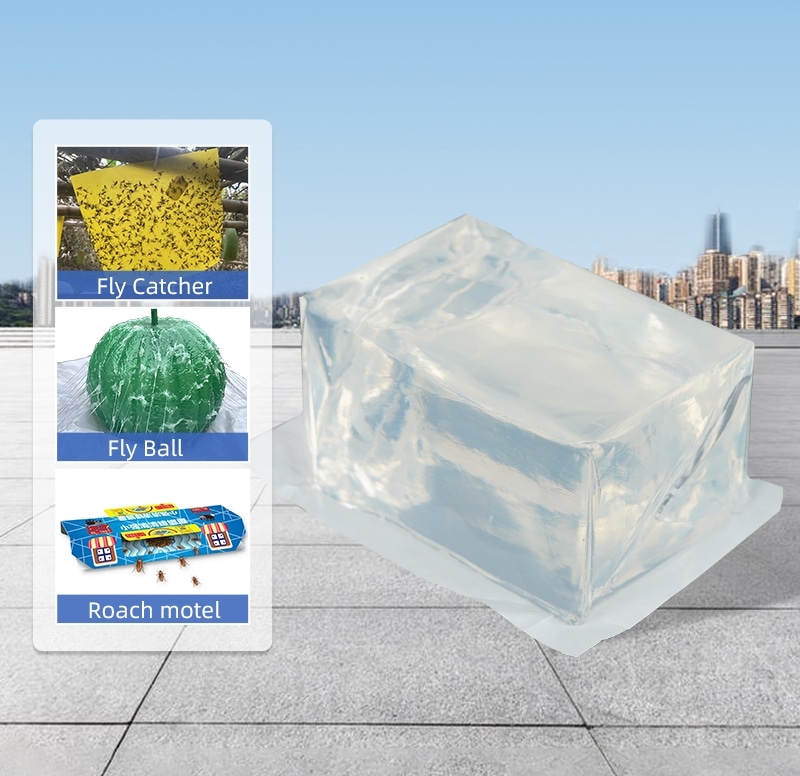
A reliable supplier not only delivers high-quality products but also provides support during the product development process.
Importance of Technical Support and Customization Capability
Suppliers with the ability to adjust the formulation in order to better meet specific substrate types or environmental conditions enable manufacturers to achieve optimal results in different orchard locations. In addition, their technical staff is able to make changes to the coating equipment in order to better meet manufacturer’s production line requirements. Manufacturers can then fine-tune the formulation as needed in the event that the manufacturer uses a new substrate or encounters different environmental conditions.
Evaluating Supplier Quality Control Systems
A reliable supplier of agricultural coatings is operating from ISO-certified facilities where all the production processes are tracked from the raw materials all the way to the point where the finished goods are being shipped out. Internally, the supplier is conducting regular audits to ensure that the measurements of viscosity, color index and the level of tack are accurate and are within the set parameters for all the batches being produced. In addition, the supplier is being transparent in providing all the necessary documentation to aid in the compliance to agricultural safety regulations with regards to the use of chemical coatings that are to be used outdoors.
Who Is Hangzhou Boiling Adhesive Technology Co., Ltd.?
Hangzhou Boiling Adhesive Technology Co., Ltd is able to develop pressure sensitive hot melt adhesives for agricultural pest control products, for example the fly trap balls used in the orchards and gardens world wide. The company carries out research and development and manufacture of the adhesives on a large scale. The company can offer adhesives that are manufactured on a custom basis for different materials of substrates and also offer expertise on the coating process. They have a comprehensive quality assurance program in place which is able to guarantee a stable supply of the adhesives by testing.
Wniosek
Selecting the appropriate pressure sensitive hot melt adhesive is critical and is typically a trade off between key parameters such as adhesive strength, weatherability, substrate suitability and cost. A well formulated PSA provides the optimal level of tack enabling efficient trapping and also maintaining this level of tack through the varied environmental conditions found in the orchard and garden. A long lasting adhesive will reduce the frequency of maintenance thereby aiding effective pest management over time. Working with an experienced supplier of adhesives will also afford access to technical experts who can advise on the most suitable product to ensure optimal product performance.
Często zadawane pytania
What temperature range should a pressure sensitive hot melt adhesive operate within for outdoor fly traps?
Pressure sensitive hot melt adhesives for outdoor fly traps should be selected according to the actual climate and application season. Most formulations achieve better tack and catching performance under moderate outdoor temperatures, typically around 20°C to 40°C. At low temperatures, the adhesive may become harder and lose initial tack, while at high temperatures it may soften or show flow risk. Therefore, summer-grade, winter-grade, or climate-specific formulations are usually recommended for long-term outdoor use.
What properties are important for pressure sensitive hot melt adhesives used in outdoor fly traps?
Outdoor fly trap adhesives should maintain stable tack, good weather resistance, and long-lasting adhesion under sunlight, humidity, dust, and changing temperatures. The formulation should also reduce excessive flow in hot conditions and avoid becoming too hard in cooler environments, so that the trap can keep effective insect-catching performance during outdoor use.
Can one formulation suit all orchard environments?
No. Regional extremes of temperature, humidity and UV radiation can be so extreme that standard trap-lid formulations can not be optimised for maximum efficiency in all locations and that formulations can be designed to optimize performance for specific geographical regions.
 Skonsultuj się
 aplikacji Whatsapp
 Zostaw wiadomość
 góra
góra