





Table of Contents
Related news
Hot Melt Adhesive for Fiberglass Cloth Tape: Wetting an Open Weave Without Stiffening the Backing
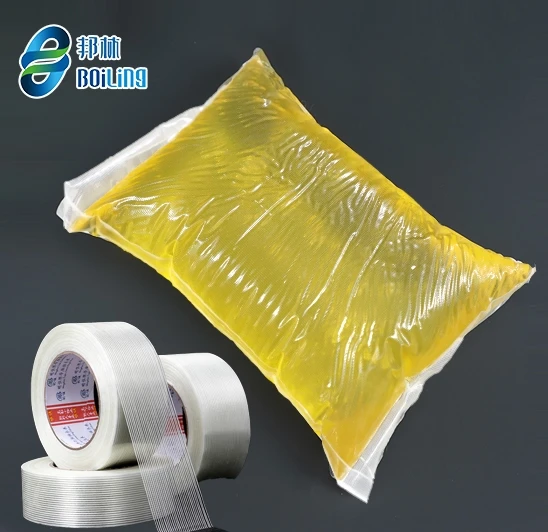
Coat fiberglass cloth tape wrong and it fails one of two ways, though a single variable is behind both — the amount of adhesive the open weave ends up holding. Underfeed it and strands stay dry underneath, which shows up later as a peel that travels strip by strip since contact exists only on the filament tops. Overfeed and the backing becomes a board; the fibres lie cemented flat, a carton corner is beyond the tape’s draping ability, and rolls telescope apart inside the box. A viable formulation must achieve full wetting of the glass weave while retaining substrate flexibility, so grade selection starts from flow-into-gaps behaviour before anybody compares stick. Softening point 80-110°C, melt viscosity 5000-7000 cps at 180°C, coating temperature kept inside 150-180°C — the band is not wide.
Why an Open Weave Is a Different Coating Problem
Against a BOPP film the adhesive sits on top and stays there, because a film is a wall. Glass cloth is a sieve. Plain weave and cross-weave cloth present open grids of filament bundles with nothing but air between them, and molten glue heads straight into those gaps on contact. Penetration isn’t a defect to eliminate here — it’s the job, since the underside strands need surrounding by glue or the tape will bond through nothing but the high points of the weave, where one lifted edge opens a strand-by-strand peel. Past a certain point, though, the glue that vanished into the grid is glue missing from above the surface, and fibres bonded to their neighbours stop acting like fabric and start acting like sheet plastic.
Encase the filaments without cementing them into a board. Every number below serves that one sentence.
Reading the Adhesive Spec Sheet for Glass Backings
Adhesives built for fiberglass cloth substrates are formulated around synthetic rubber bases with rheology designed for this coating behaviour. BoiLing’s glass fiber mesh tape grade runs a softening point of 80-110°C and 5000-7000 cps viscosity at 180°C, applied at 150-180°C. Each specification parameter controls the following behaviour on fiberglass coating lines:
|
Spec line |
What it controls on a glass-cloth line |
Wrong end of the range |
|
Softening point 80-110°C |
How the cured layer behaves once heat arrives — hot warehouse, a container in July |
Under the band and wound layers block together; above it the hand goes stiff and wet-out suffers |
|
Viscosity 5000-7000 cps @180°C |
How deep molten glue travels into the weave before it freezes |
A thin melt strikes through and dirties the backside, a thick one leaves strands dry |
|
Application temperature 150-180°C |
The window where flow and open time stay balanced |
Past 180°C tack degrades and odour appears; below 150°C the roller stops transferring properly |
|
Cohesion (internal strength) |
Whether the layer survives load without migrating onto whatever it touches |
Thin cohesion shows up as adhesive left on appliance surfaces after the tape comes off |
Cohesion earns extra attention on this family for a simple reason: filament-reinforced tape gets asked to strap washing machines, bundle pallets and hold appliance trays in place, and every one of those jobs ends with somebody peeling the tape off without wanting rubber left behind. Wet-out can be textbook and the lab peel numbers pretty, yet a thin-cohesion grade still surfaces months later as residue complaints from the field.
Mesh Count Sets the Coating Weight, Not the Other Way Round
Cloth weight and mesh size decide how much adhesive the backing absorbs per square metre. Fine mesh with dense filament bundles drinks more than a sparse grid, and the same meter head settings will not run both. The sequence on a new backing: measure cloth weight, estimate the absorption the grid geometry allows, then set coat weight as penetration allowance plus a bonding film above the surface. Changing mesh count mid-production without touching adhesive settings is how half a batch ends up either bone dry or board stiff.
Line Settings That Keep Both Sides of the Trade Safe
Melting practice comes first. These grades melt at 160-180°C with a preheat of at least 40 minutes, and the tank should sit at no more than 85% capacity so the glue isn’t holding molten longer than it needs to. Extended heat history thins the polymer and pushes viscosity down, which reads on the next roll as strike-through the weave — the same symptom as running a grade that’s too thin, caused entirely by the kettle schedule.
The maintenance calendar — filters daily, heating weekly, temperature calibration monthly — exists in the operating guide because a partly blocked filter shifts coat weight slowly, roll by roll, in the direction of stiff backing. Nobody catches it at the machine; a customer saying the tape won’t wrap a corner is usually where it surfaces.
Three settings carry the rest:
- Coat weight— set from the cloth, then confirmed by hand. A properly coated strip flexes with a slight fabric creak; a flooded strip snaps back flat with a glazed surface.
- Backing temperature at transfer— cool glass accepts more glue than warm glass. Pre-heating cloth in a cold winter shop reduces the shock-freeze that leaves strand tops dry.
- Line speed versus open time— the coating must meet the cloth and set in a matched rhythm. Tape factories running short open-time grades on fast lines covered that trade-off in depth on the high-speed coating line guide; fiberglass backings make the same maths tighter because a half-wet weave doesn’t announce itself.
Failure Patterns Worth Keeping on the Wall
|
Symptom on finished rolls |
Most likely cause |
First check |
|
Peel comes off in strips, glue sits on tape not surface |
Dry strands — coating never entered the weave |
Melt temperature and tank level; whether viscosity drifted after long heat exposure |
|
Glue dots on the release side of the wound roll |
Strike-through from over-penetration |
Coat weight, mesh count change, adhesive held molten too long |
|
Backing stiff, tape cracks at folds |
Weave cemented solid |
Coat weight above what the grid geometry can carry |
|
Adhesive residue left on the appliance or carton |
Cohesion too weak for the load, or the wrong grade |
Confirm the grade was built for fiberglass backings, not a film-tape grade |
|
Edge lift after strapping pallets |
Initial tack out of balance with coating speed |
Line speed, contact roller pressure |
Four of the five rows start by checking the line before blaming the glue, and that ordering is deliberate — a fiberglass coating complaint is more often settings drift than formulation error.
Sampling a New Grade Without Burning a Production Day
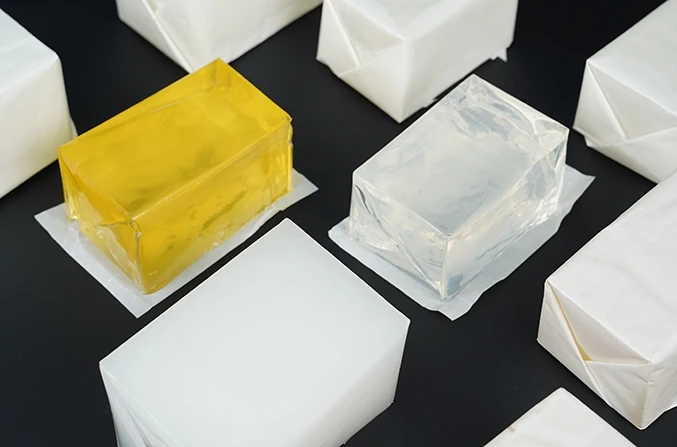
Before committing a run, ask for sample material (block samples are standard, freight typically on the buyer) and run the check list on a small coat:
- Three cloth lots if available — mesh counts drift between cloth suppliers more than tape factories admit.
- Coat at the low, middle and high end of 150-180°C; note where the weave wets fully without the surface going glazed.
- Wind a small roll, store 48 hours at ambient, unwind and look for blocking and glue transfer.
- Strap two weighted cartons, hold 24 hours at room temperature and 24 hours somewhere warm — a hot warehouse is where weak cohesion reveals itself.
- Peel slowly from metal and inspect both faces for residue.
Sample material arrives with MSDS and TDS. A shop still arguing the cost split between hot melt and acrylic PSA ought to coat both chemistries on its own glass cloth before believing any spreadsheet, since an open weave behaves differently under each one and the cloth, not the datasheet, settles the comparison. Lines running kraft or PET or aluminum besides glass find the whole tape adhesive range under one roof.
FAQ
Spec sheets read differently when the coating line reads them. Three questions a tape factory’s production manager asks first:
Can one adhesive run both mono-weave and cross-weave cloth?
Usually yes, with settings changed rather than the drum. Cross-weave presents more filament surface and tighter pockets, so penetration per square metre differs; the grade selection starts from the same fiberglass cloth spec and the coat weight moves per mesh count.
Why does a correctly coated roll still teleoscope?
Tension and winding carry part of this story, but a tape whose backing was softened by over-penetration also loses the dimensional stability that keeps a wound roll square. Check hand stiffness across the width before blaming the slitter.
Which is worse for filament tape — dry strands or flooded weave?
For the product itself, a flooded weave wins the argument for worst — a backing stiff as board cannot wrap a corner, rendering the tape unable to conform around corners. Dry strands are worse for tomorrow’s production schedule, though, since a peel failure keeps travelling quietly toward end customers while stiffness gets caught at the slitter, on your own floor, while you still control it.
Nearly twenty years of making hot melt adhesive, block-form pressure sensitive grades shipped to tape producers in 23 Chinese provinces plus buyers across Southeast Asia, the Middle East and South America — that’s BoiLing. BOPP, fabric, kraft paper, PET, aluminum and fiberglass backings all have a grade in the range, samples and TDS arrive before any production commitment, and annual capacity sits at 25,000 tons. A conversation about a specific cloth starts at the contact page.
 Consult
 Whatsapp
 Leave Message
 top